Explorers for Kids: The Ultimate Guide to the Most Famous World Explorers

If your kids are starting to learn about history, geography, or early explorers of America, this guide will become your go-to. We’re talking world explorers, famous explorers in history, one incredible female guide who changed everything, and simple explanations your kids can actually understand. Whether you’re homeschooling, teaching, or just raising a curious kid who wants to know “who sailed where,” this post gives you everything in one place.
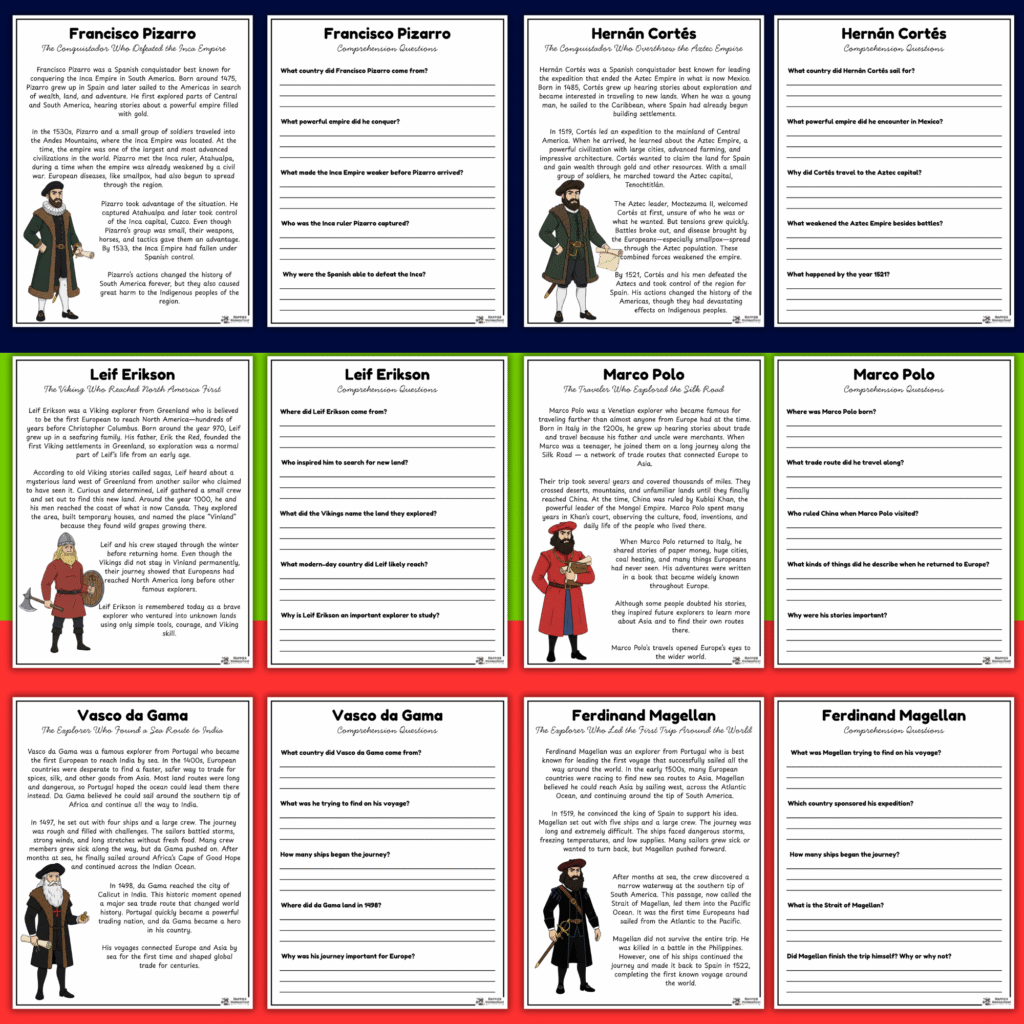
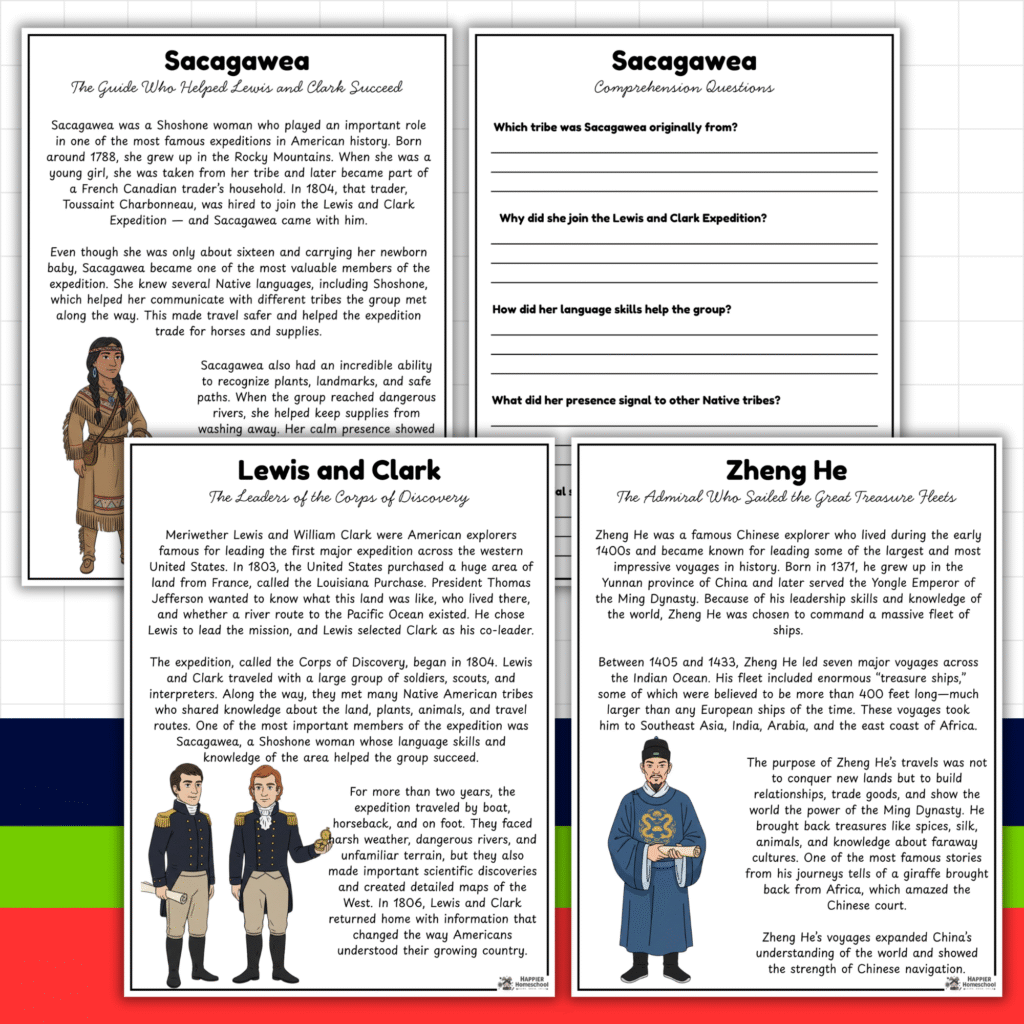
And because I know you love open-and-go resources, I also created a free 31-page “Explorers for Kids” printable you can download and use right away. It includes a full page on each explorer, comprehension questions, and a fun riddle activity to help the learning stick.
Let’s jump into the explorers every elementary student should know.
Meet the Most Famous Explorers for Kids in History
Below are the explorers kids study most often. Each one has left a giant footprint on world history, and each one has a kid-friendly explanation you can read aloud or turn into a mini-lesson.
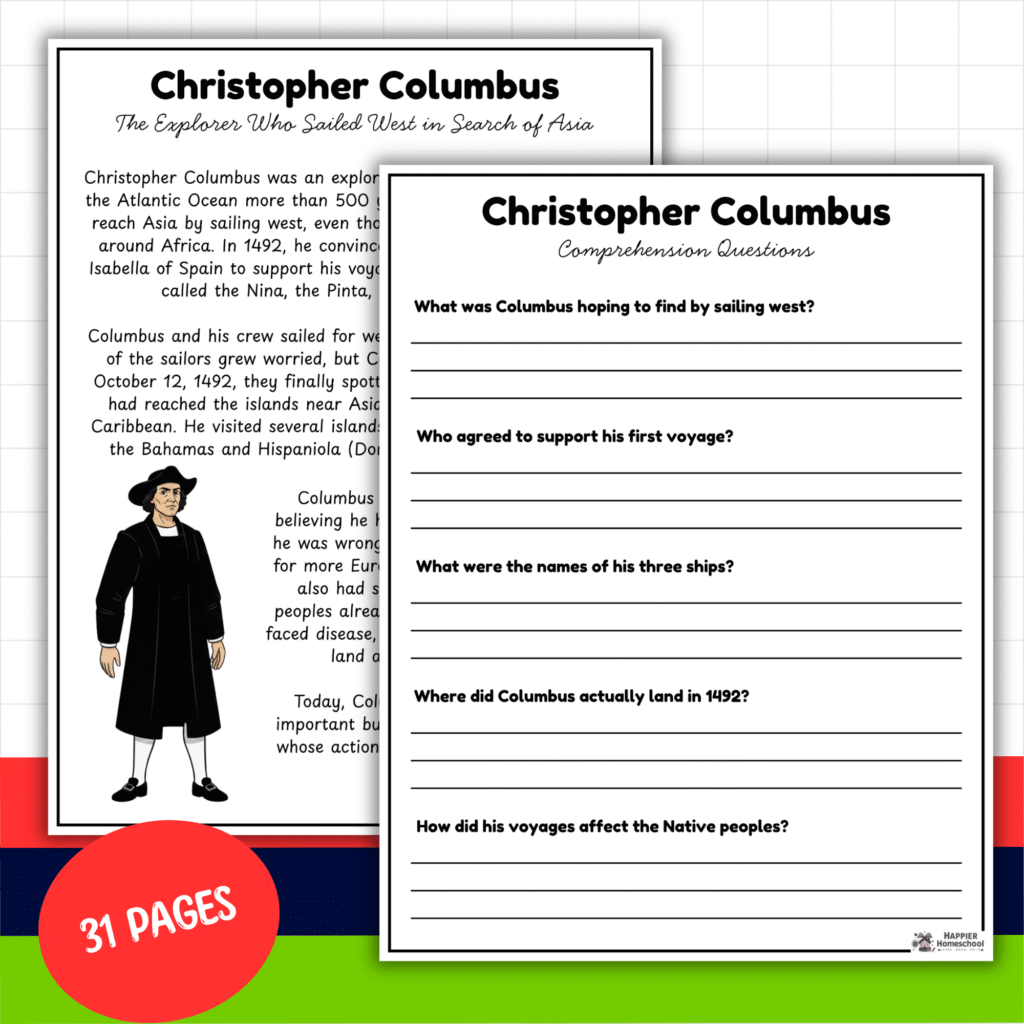
Christopher Columbus – The Explorer Who Sailed West in Search of Asia
Columbus sailed from Spain in 1492 hoping to reach Asia by going west. Instead, he landed in the Caribbean, which opened the door for more European exploration. Kids learn his name early because his voyages connected Europe and the Americas, bringing big changes—good and bad—that shaped history.
Ferdinand Magellan – The Explorer Who Led the First Trip Around the World
Magellan set out to find a western sea route to Asia. His crew, not Magellan himself, completed the first circumnavigation of the Earth. This journey proved how vast the world really is and made Magellan one of the most important world explorers to study.
Vasco da Gama – The Explorer Who Found a Sea Route to India
Da Gama sailed around Africa’s Cape of Good Hope and reached India. His success transformed global trade by connecting Europe and Asia entirely by sea. This makes him a major figure in world exploration and geography lessons.
Marco Polo – The Traveler Who Explored the Silk Road
Marco Polo traveled from Italy to China along the Silk Road. His stories introduced Europeans to Asian life, cities, inventions, and culture long before any ocean voyages happened. He’s perfect for kids who love adventure and discovery.
Leif Erikson – The Viking Who Reached North America First
Around the year 1000, Leif Erikson and his Viking crew reached what is now Canada, long before Columbus sailed. Kids love the idea of Vikings exploring the world with skill and courage, and he fits perfectly into lessons on early explorers of America.
Hernán Cortés – The Conquistador Who Overthrew the Aztec Empire
Cortés arrived in Mexico in 1519 and eventually defeated the Aztec Empire. His arrival changed the region forever and had serious consequences for Indigenous peoples. He’s often taught to help kids understand European expansion and its impact.
Francisco Pizarro – The Conquistador Who Defeated the Inca Empire
Pizarro conquered the Inca Empire in South America with a small group of soldiers. His story shows how European conquest spread across the Americas and how Native civilizations were affected.
Juan Ponce de León – The Explorer Who Searched for the Fountain of Youth
Ponce de León was the first recorded European to land in Florida. Kids find him memorable because of the legend of the “Fountain of Youth,” which makes history feel a little more magical.
Henry Hudson – The Explorer Who Searched for the Northwest Passage
Hudson explored the areas that now bear his name—the Hudson River and Hudson Bay—while searching for a shortcut through North America to Asia. His voyages are a great way to introduce mapping skills and early American geography.
Amerigo Vespucci – The Explorer Who Realized the New World Was a New Continent
Vespucci’s letters helped mapmakers understand that the land Columbus reached was not Asia. His observations led to the naming of North and South America, which makes him an essential part of any “all about explorers” lesson.
John Cabot – The Explorer Who Reached Canada for England
Cabot sailed for England and reached the coast of Canada in 1497. His explorations encouraged England to begin colonizing North America, which plays a huge role in early American history lessons.
James Cook – The Explorer Who Mapped the Pacific
Cook explored Australia, New Zealand, and Pacific islands while creating some of the most accurate maps of the time. His voyages combine science, exploration, and geography, which makes him a favorite in classrooms.
Sacagawea – The Guide Who Helped Lewis and Clark Succeed
As a young Shoshone woman carrying her newborn, Sacagawea guided Lewis and Clark through the West. Her knowledge of languages, plants, and safe routes made their journey possible. She is one of the most famous female explorers kids will ever learn about.
Lewis & Clark – The Leaders of the Corps of Discovery
These two explorers mapped the Louisiana Territory and traveled from St. Louis to the Pacific Ocean. Their journals gave Americans a deeper understanding of the land, plants, animals, and Native tribes.
Zheng He – The Admiral Who Led the Treasure Fleets
Zheng He commanded enormous Chinese ships and traveled to India, Arabia, and East Africa long before many European explorers set sail. Studying him helps kids see a wider picture of world explorers outside of Europe and America.
How to Use This Explorers for Kids Printable in Your Lessons
1. Build a mini-history unit
Use one explorer per day for two to three weeks. This keeps kids engaged without overwhelming them.
2. Use it as a geography add-on
Have your child mark each explorer’s route on a blank world map. Magellan, Zheng He, and da Gama are perfect for this.
3. Add it to your morning work routine
A quick passage + five questions = quiet focus while you reset the morning chaos.
4. Make it independent work time
If you’ve got multiple kids working on different subjects, this packet lets one child work solo with zero prep on your part.
5. Use the riddle page as a fun review
It doubles as an assessment without feeling like a test.
6. Keep it in your sub-plan binder
Teachers love having grab-and-go pages that don’t require instructions.
Why Teaching Explorers for Kids Matters
Kids learn more than names and dates. They learn curiosity, bravery, problem-solving, geography, cultures, and how different parts of the world connect. And when they see how big and complex history is, they start asking better questions — which is exactly what we want.
Check out the American Revolution Flip Book too!
Download Explorers for Kids Printable
If you don’t feel like piecing together lesson plans for every explorer, you can download my free 31-page explorers for kids printable that covers every explorer listed above. This printable includes:
• 200-word reading passages
• 5 comprehension questions for each explorer
• one “Which Explorer Am I?” riddle page to tie it all together
It works beautifully for history units, geography lessons, morning work, reading comprehension, or a quick independent assignment when you need a minute to breathe.
This explorers for kids printable is classroom-friendly, homeschool-friendly, and honestly lifesaving on days when your brain is already juggling eight things.
🚀Want this printable plus dozens of other free homeschool resources?
Join my FREE VIP Printable Library below to download everything in one place, or log in here and enter the password from your welcome email if you’re already a member.🚀 (Find it in the History section!)