What Is a Paleontologist for Kids? A Fun Guide to Fossils, Dinosaurs, and Digging Up the Past

Table of Contents
If your child has suddenly entered the dinosaur era (you know the one), you’ve probably heard the question “What is a paleontologist for kids?” more than once. Kids want to understand who these scientists are, how they find dinosaur bones, and why fossils matter. And they don’t want the grown-up museum version — they want the kid version that actually makes sense.
That’s what this guide is for. We’re breaking down what a paleontologist does, what paleontologists study, and how fossils help us learn about life millions of years ago. And to make learning hands-on, I put together a free 21-page paleontology activity pack your kids can use as they read and explore.
Let’s make science fun today.
Let’s dig in. (Yes, I had to say it.)
So… What Is a Paleontologist for Kids?
A paleontologist is a scientist who studies things that lived long before humans ever existed. That means animals, plants, and tiny creatures that only show up today as fossils. If your child has ever picked up a rock and yelled “LOOK! A dinosaur bone!” then congratulations—you already have a paleontologist in training.
Paleontologists spend a lot of time outdoors at places called dig sites. These spots are usually areas where ancient plants or animals are buried under layers of dirt and rock. Their job is to carefully uncover fossils so we can learn what Earth looked like millions of years ago.
You can think of a paleontologist as part detective, part scientist, and part puzzle-solver. Every fossil they find gives them a clue about creatures from the past.
What Do Paleontologists Study?
This is the part that kids love: paleontologists study fossils.
Fossils can be:
- Bones
- Shells
- Footprints
- Leaf or plant imprints
- Entire skeletons preserved in rock
Basically, fossils are the preserved remains or impressions of something ancient. If you’re ever answering your child’s question “scientists who study fossils are called…?” the answer is paleontologists.
But fossils aren’t the only thing they study. They also look at how animals moved, what they might have eaten, what their environment looked like, and how different species changed over time.
So when your kid says, “How do we know what dinosaurs ate?” it’s because paleontologists were able to study fossil teeth, bones, and sometimes even fossilized stomach contents. Yes, that’s a real thing.
What Is the Study of Dinosaurs Called?
Kids ask this all the time: “What is the study of dinosaurs called?” The answer is paleontology.
Paleontology includes dinosaurs, but it also covers ancient plants, sea creatures, insects, and early mammals. If it lived long ago and left behind evidence, paleontology covers it.
Dinosaur study is just a very popular branch because kids are straight-up obsessed with these creatures. Honestly, adults too.
How Do Fossils Actually Form?
We make fossils sound casual, but fossil formation takes millions of years. Here’s the kid-friendly breakdown:
- A plant or animal dies.
- It gets covered by mud, sand, or rock.
- Soft parts break down.
- Hard parts stay buried.
- Minerals slowly replace the bones or shell.
- It becomes a fossil hidden underground.
Then one day a paleontologist discovers it, brushes off the dirt, and suddenly we’re learning about something that hasn’t walked this Earth in forever.
What Tools Do Paleontologists Use?
Kids love this part because the tools feel like a mix between a treasure hunt and a science mission. Paleontologists often use:
- Rock picks – to break away tough rock
- Brushes – to gently dust fossils
- Chisels – to loosen stone
- Magnifying glasses – to see tiny details
- Field notebooks – to sketch and write observations
They work slowly on purpose. One wrong move and that fossil can break into pieces. This is why paleontologists are patient in a way only someone who works with rocks from 70 million years ago can be.
Free 21-Page Paleontology Activities for Kids
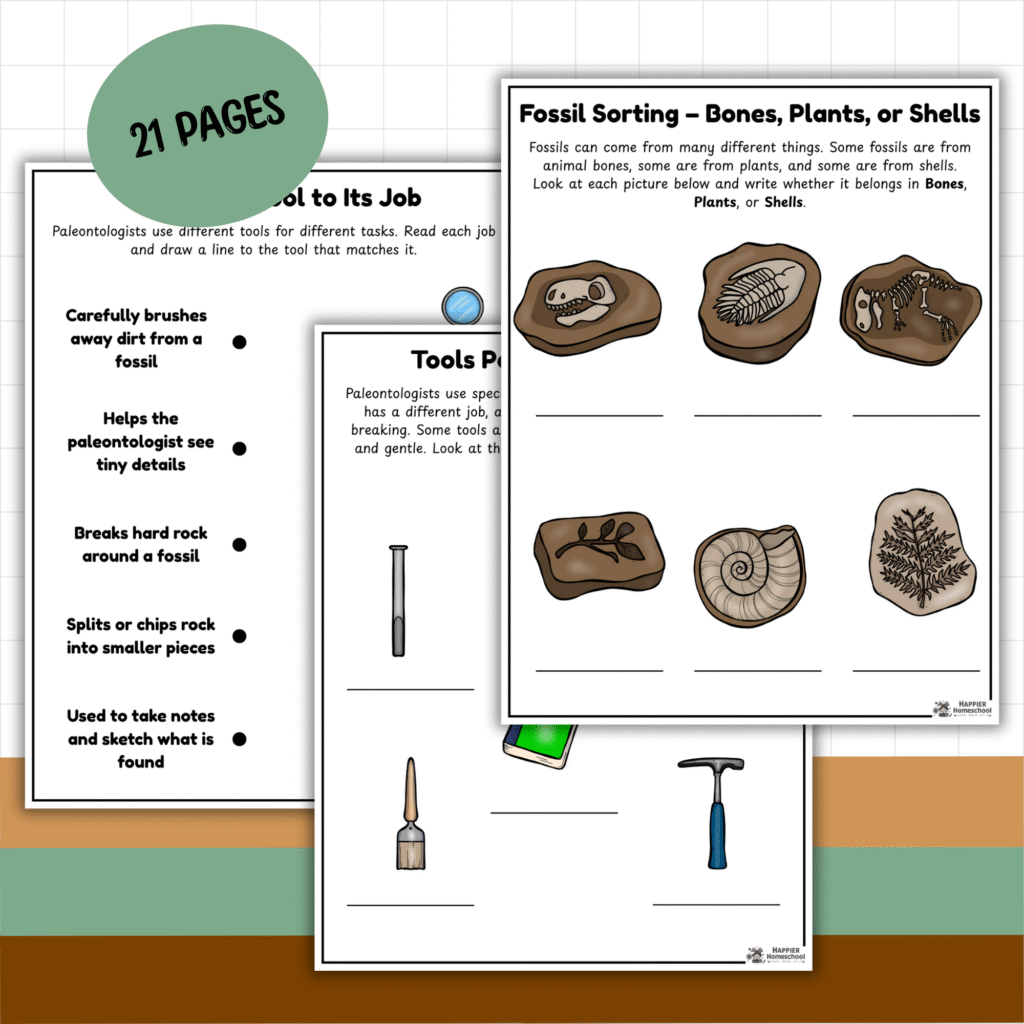
If your kid is already interested, this is the perfect time to add hands-on learning. I created a free 21-page printable packed with paleontology activities for kids so they can learn about fossils, tools, and dig sites in a way that actually sticks.
Inside the printable, you’ll find:
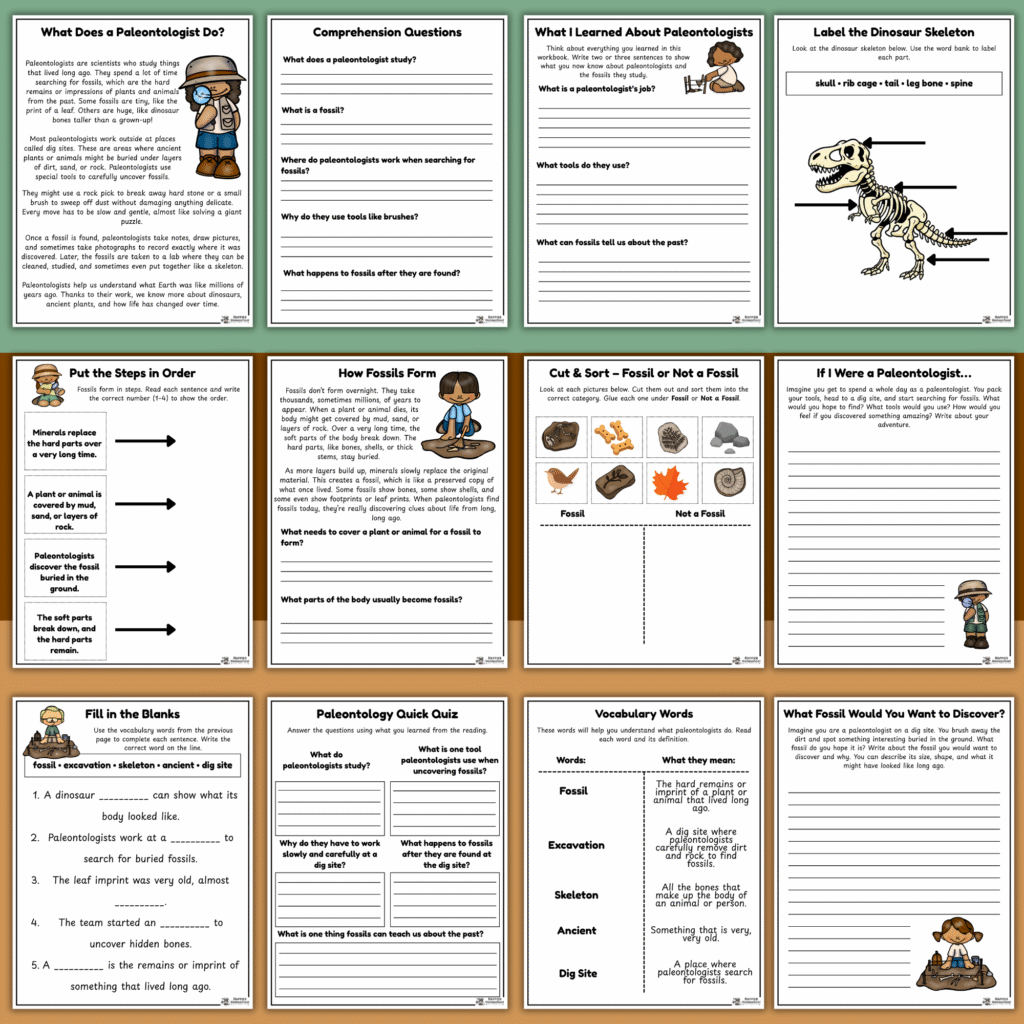
- A kid-friendly reading passage explaining “What is a paleontologist?”
- Tool labeling pages
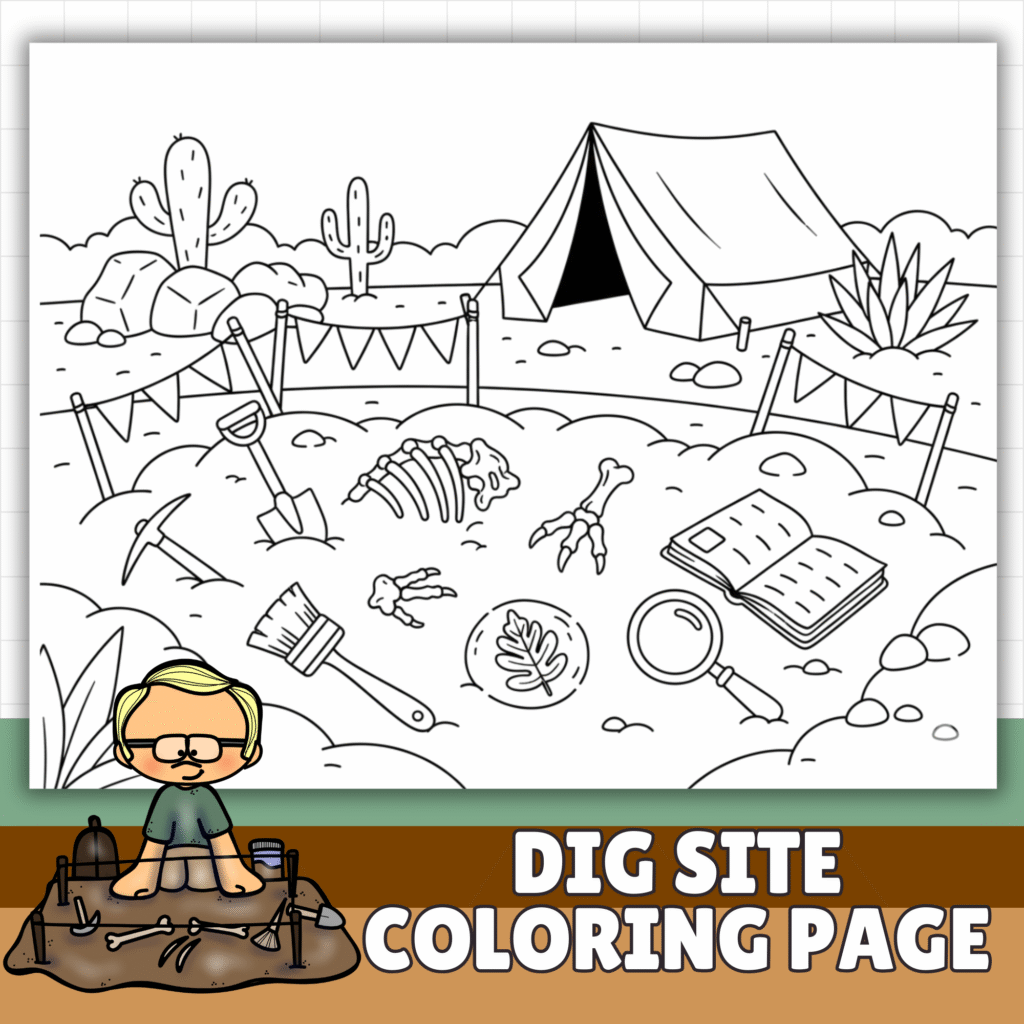
- A dig site coloring page
- Fossil sorting (bones, plants, shells)
- Vocabulary + definitions
- Fill-in-the-blank vocabulary practice
- Two writing prompts
- A mini reading passage on how fossils form
- A fossil sequencing activity
- A cut-and-sort page (fossil vs not a fossil)
- Dinosaur skeleton labeling page
- A final “What I Learned” reflection page
- 5 full answer pages in the back
It’s a perfect combination of reading, writing, science, and hands-on activities. Teachers can use it. Homeschool parents can use it. Kids can use it independently.
And yes, paleontology activities for kids really do help build vocabulary, science understanding, reading comprehension, and confidence. It hits a lot of standards without feeling like a boring school assignment.
Why Kids Love Learning About Paleontologists
There’s something magical about the idea of finding a dinosaur bone buried underground. Kids love mystery. They love big discoveries. And they love learning about creatures that feel too wild to be real.
Learning about paleontologists taps into every single one of those interests. It feels like adventure learning instead of “sit down and memorize this.”
Plus, it answers the questions kids naturally ask:
- Why don’t we see dinosaurs today?
- How do we know what they looked like?
- Who finds dinosaur bones?
- How do scientists know their age?
And honestly, it gives parents an easy way to introduce science without needing a lab coat or a museum trip.
How to Use These Paleontology Activities at Home
Once you download the free 21-page printable, you can use it in a few different ways:
1. Make it a mini unit study. Spend a few days doing 3–4 pages at a time.
2. Use it during morning work. A single page a day gives kids a gentle science warm-up.
3. Pair it with dinosaur books. Even the most basic dino book becomes more meaningful when kids understand what fossils are.
4. Set up a pretend dig site. Hide toy bones in sand or kinetic sand and let your kids “excavate.”
5. Use it for quiet time or independent learning. Kids can do most of these activities on their own.
Final Thoughts: Raising the Next Little Scientist
If your child has ever stopped you on a walk to show you a cool rock, or pointed out a fossil imprint in a museum, you’re already raising a curious little explorer. Teaching what is a paleontologist for kids—and what paleontologists study—opens the door to a world full of science, discovery, and imagination.
And now you’ve got everything you need to make that lesson stick:
A simple explanation, fun facts, and a free 21-page pack of paleontology activities for kids that makes learning feel like an adventure.
Download the What Is a Paleontologist for Kids Printable
🚀Want this printable plus dozens of other free homeschool resources?
Join my FREE VIP Printable Library below to download everything in one place, or log in here and enter the password from your welcome email if you’re already a member.🚀 (Find it in the Jobs for Kids section!)