
What Is the Water Cycle? 1 Free Mini Flip Book!

Table of Contents
If your child is just starting to explore Earth science, one of the first big questions they’ll ask is “What is the water cycle?” And honestly, it’s such a fun topic to teach because you can see it happening all around you – in the rain, in the clouds, in puddles, in your kitchen, everywhere.
Kids pick this one up fast when the activities are hands-on and the explanations actually make sense. So today we’re walking through what the water cycle is, how it works, and a ton of learning ideas you can use at home. I’ll also share a free printable you can use right away plus a deeper unit study you can grab if you want to turn this into a full week of science lessons.
Let’s start with the basics on what is the water cycle.
What Is the Water Cycle?
The water cycle is the process that keeps Earth’s water constantly moving. Water doesn’t ever disappear, it just changes form and travels from place to place in a big repeating loop.
Every time it rains, snows, or you see steam rise from boiling water, you’re watching the water cycle happen. And the cool part? This same water has been cycling since dinosaurs roamed the earth.
When kids understand this, science suddenly feels way more magical.
The 4 Main Stages of the Water Cycle
To really answer “What is the water cycle?”, you want to break it down into four steps. These are the stages kids need to know for elementary science worksheets, activities, and unit studies.
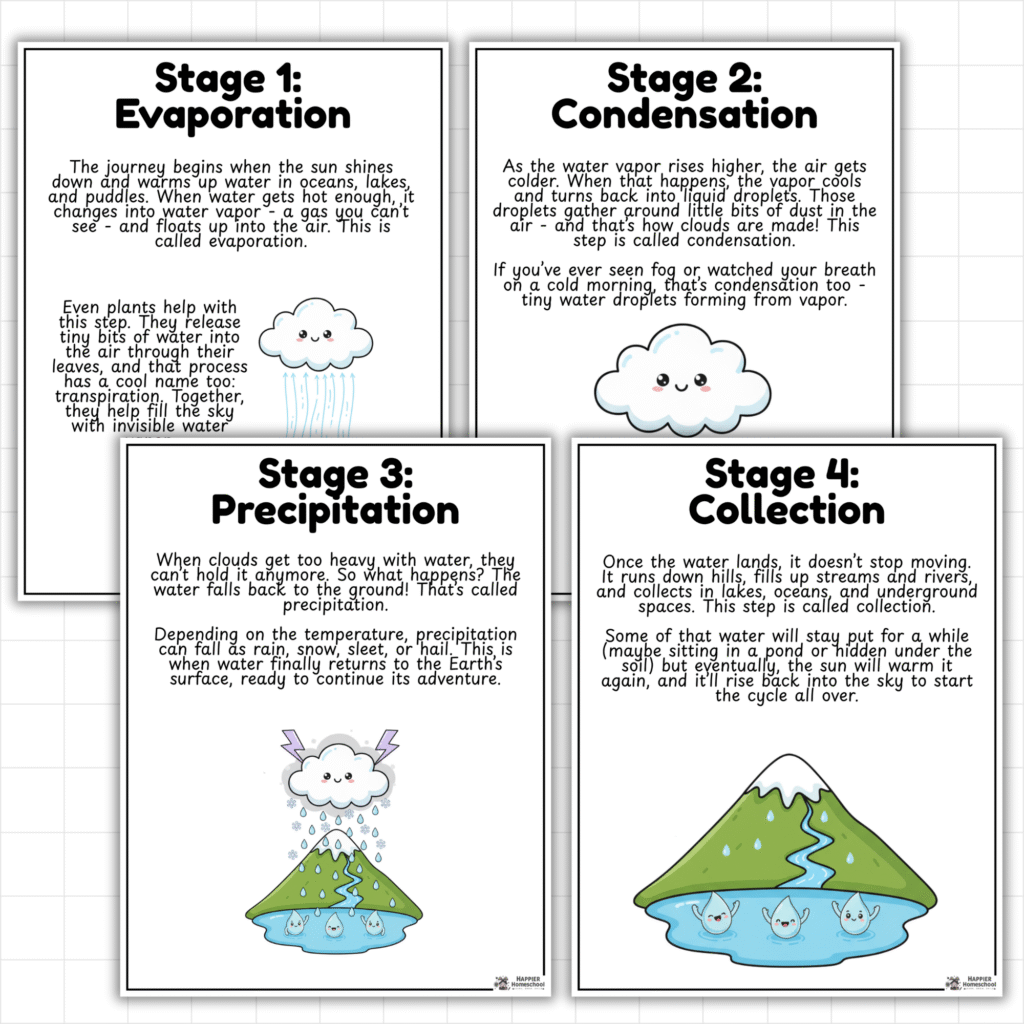
1. Evaporation
This is what happens when the sun heats up water from lakes, oceans, puddles, or even a cup sitting on the table. Warm water turns into water vapor, an invisible gas that floats up into the air.
Great kid example: Watching steam rise from a pot or seeing a wet sidewalk dry in the sun.
2. Condensation
When all that water vapor cools down high in the sky, it turns back into tiny water droplets. These droplets group together to form clouds. That cooling-down process is called condensation.
For example, The foggy mirror after a shower.
3. Precipitation
When clouds get heavy and can’t hold any more water, they let it go. This release of water is called precipitation, and it can fall as:
- Rain
- Snow
- Sleet
- Hail
Kid example: Literally any rainy day in real life.
4. Collection
Once the water hits the ground, it collects in:
- Rivers
- Lakes
- Oceans
- Puddles
Some water soaks into the soil (groundwater), and some gets taken up by plants.
Then the sun warms everything again… and the cycle starts over.
That’s the full water cycle loop: evaporation → condensation → precipitation → collection.
Why the Water Cycle Matters for Kids
Kids need to learn about the water cycle because it helps explain:
- Why weather changes
- How clouds form
- Why it rains
- How plants get water
- Why we always have water even when it seems like we shouldn’t
It’s one of the core units in all Earth Science lessons for grades 2–4, and it connects with so many other topics — weather, climate, natural resources, states of matter, ecosystems, you name it.
And when you combine clear explanations with water cycle printables, hands-on activities, and simple diagrams, the learning just clicks.
Hands-On Ways to Teach the Water Cycle
If your child learns best by doing, here are a few easy water cycle activities that require almost no prep and reinforce exactly what they read or see in worksheets.
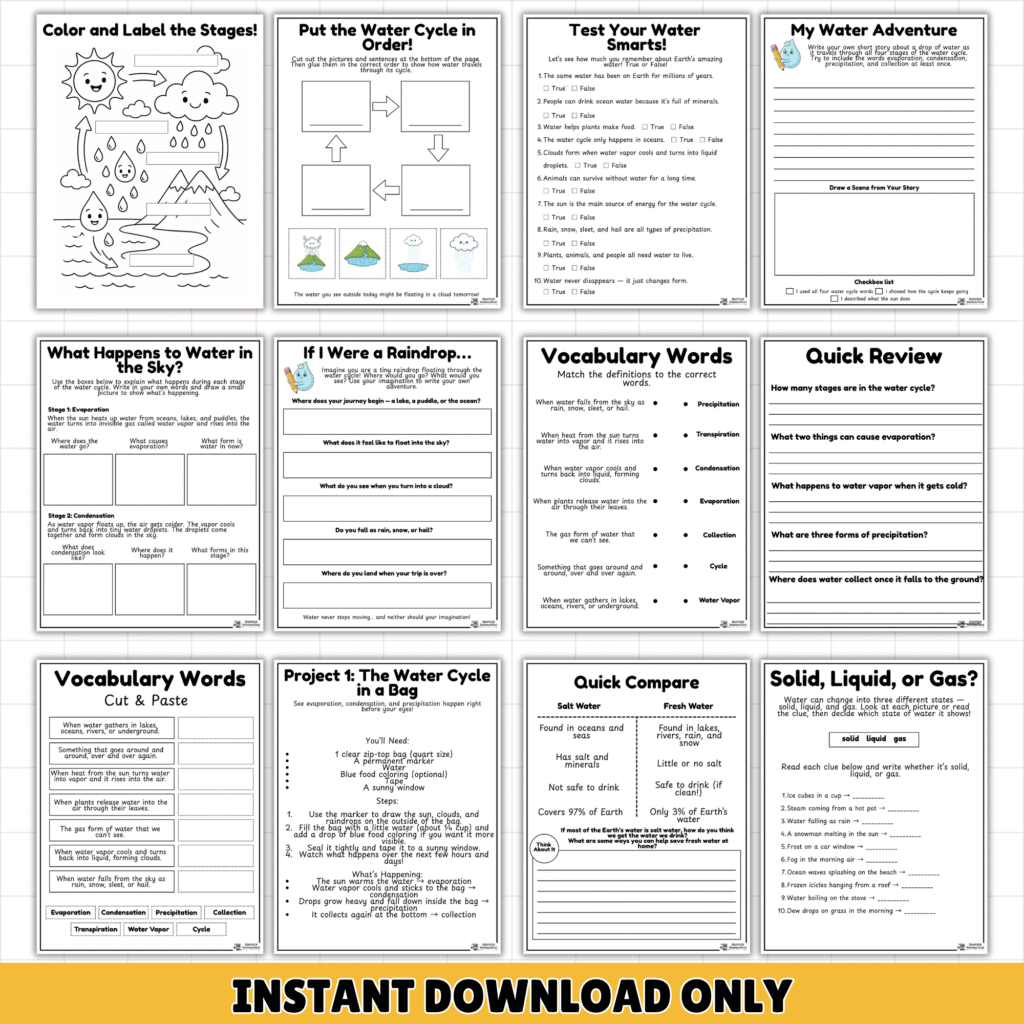
Water Cycle in a Bag
All you need is a clear zip bag, water, a sunny window, and a marker.
Kids can watch evaporation and condensation happen inside the bag without ever making a mess.
Mini Terrarium Cycle
Put a little soil, plant, and water in a jar and seal it.
Kids see condensation on the lid and watch it “rain” back into the soil.
Observing Real Precipitation
Let your child check the weather for the day and identify which type of precipitation they see.
These simple activities bring the water cycle process to life.
The 3 States of Water (A Big Part of the Water Cycle)
Before kids fully understand what the water cycle is, they need to know that water can look completely different depending on temperature.
Water can be:
- A solid (ice)
- A liquid (water)
- A gas (water vapor)
Evaporation = liquid → gas
Condensation = gas → liquid
Freezing = liquid → solid
Melting = solid → liquid
Most water cycle worksheets and unit studies include this because it makes the whole process easier to understand.
Where We Find Water in Nature
When teaching what is the water cycle, it helps kids to see where water actually lives on Earth. A few examples you can share:
Fresh water: lakes, rivers, streams
Salt water: oceans, seas
Frozen water: glaciers, ice caps
Underground water: groundwater and aquifers
Kids quickly understand that all of this water is constantly cycling.
Easy Ways to Reinforce Water Cycle Vocabulary
If your child needs repeated exposure to vocabulary, you can use:
- A word hunt
- Matching sheets
- Label-the-diagram pages
- True/false reviews
- Fill-in-the-blank sheets
These activities build confidence and help kids read science passages with fewer hiccups.
Free Water Cycle Printable for Kids
To help you get started, I created a free mini Water Cycle Flip Book that explains all four stages and includes a word hunt and creative drawing page. It’s simple, visual, and perfect for grades 2–4.
You can grab that here:
>>Download the Free Water Cycle Flip Book <<
Use it as a warm-up before diving into a full water cycle unit study.
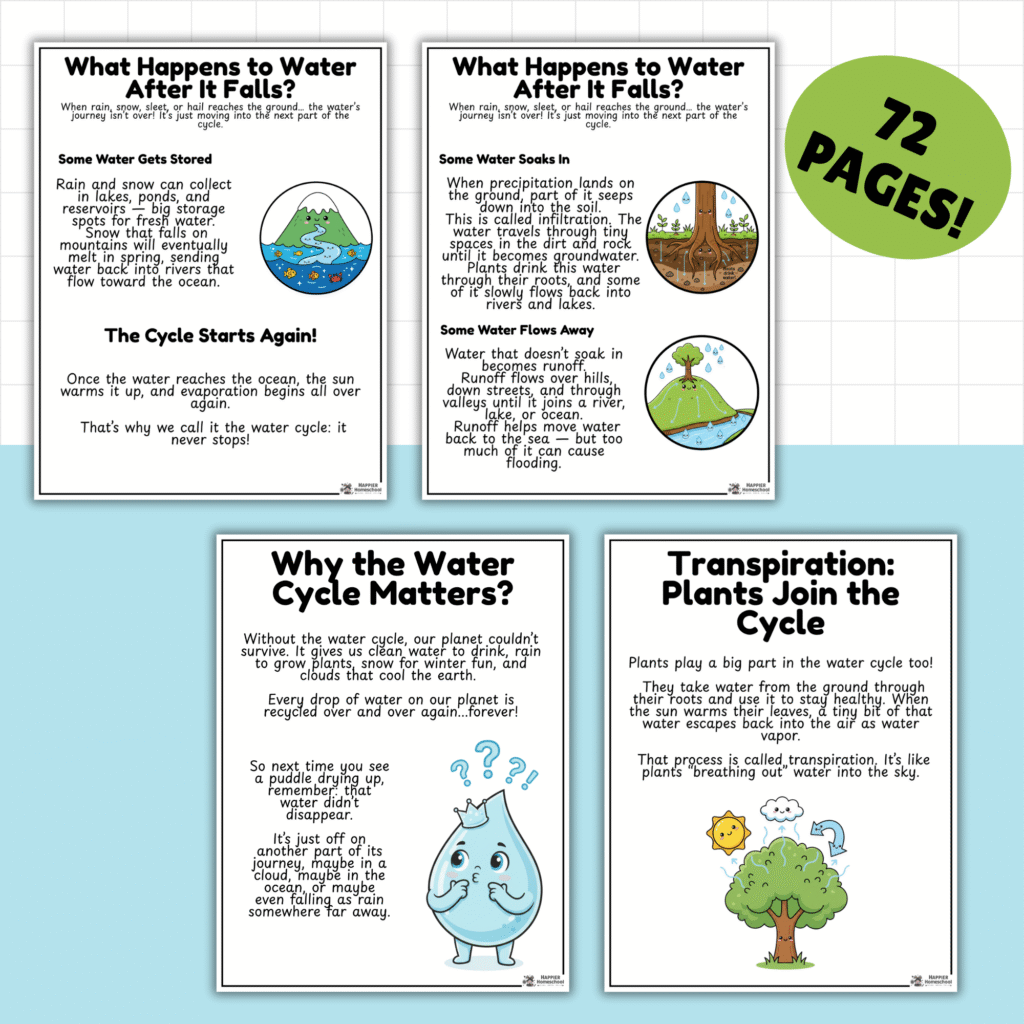
Ready to Go Deeper? Explore the Full 74-Page Water Cycle Unit Study
If your child loved learning about the water cycle and you want a full week (or more) of Earth Science lessons ready to go, you can check out my complete printable unit study.
It includes:
- 4 stages of the cycle
- Runoff, transpiration, and groundwater
- Salt vs. fresh water
- The 3 states of water
- Hands-on activities
- Vocabulary worksheets
- Comprehension pages
- A water experiment log
- Quizzes
- 5 answer keys
- Certificate of completion
It’s everything you need for a full homeschool science unit with no prep required!


